Just thought I'd post something on this blog since tomorrow it will be one month since I posted something. I wanted to post something since I haven't decided yet whether I'll keep blogging or not but obviously I don't have much to say on a blog or I'd have been posting a lot more. Fact is that I have such an active life on the internet in other places that there isn't much stuff left for a blog. That together with that my personal real life is in a bit of a funk at the moment means I don't have much to add to the ever growing information stream of the internet.
But as I said, I haven't quite decided yet whether I will continue to blog or not. I actually find blogging quite fun so I don't want to give it up but I don't want to fill the blogosphere with stuff like this post either. So we'll see what happens.
The one news I can hand out about myself at this moment though is that I'm officially unemployed as of yesterday. I've already had some leads on some work though so I think it will be alright pretty soon and maybe that will make me blog more once again :)
Wednesday, 11 June 2008


Monday, 12 May 2008
Short note on my final paper
Since I'm home sick today I thought I'd put together a quick note with the points I believe my teacher wants to know today about my final paper in the course 'information retrieval and new new media' that I am taking.
My topic is 'Real Life on the New Web' and it will take a look at how we use the web 2.0 features and how it affects us as people. Of course this might seem as a very broad subject that includes several aspects of how we work as human beings and how the internet works so I will be limiting my paper down to a few, in my opinion, key features of web 2.0 and also limit the areas of how the web affects us.
The sources I will use will mainly be Sherry Turkle's books 'The Second Self: Computers and the Human Spirit' and 'Life on the Screen: Identity in the Age of the Internet'. I will also use the internet as a source of course and quite possibly some of the other literature that can be found on our course wiki, if I find that I need it.
When it comes to structure of the final paper I must say that I have honestly no idea. As of now I have mainly just crammed out text to get to where I want to go with my thoughts surrounding this area and as I happen to be an amateur when it comes to writing these sort of papers I must admit that I am not fully sure what my teacher when he is talking about the structure of the paper. So this is something I will have to talk to my teacher about.
Well that should cover it for now hopefully.
My topic is 'Real Life on the New Web' and it will take a look at how we use the web 2.0 features and how it affects us as people. Of course this might seem as a very broad subject that includes several aspects of how we work as human beings and how the internet works so I will be limiting my paper down to a few, in my opinion, key features of web 2.0 and also limit the areas of how the web affects us.
The sources I will use will mainly be Sherry Turkle's books 'The Second Self: Computers and the Human Spirit' and 'Life on the Screen: Identity in the Age of the Internet'. I will also use the internet as a source of course and quite possibly some of the other literature that can be found on our course wiki, if I find that I need it.
When it comes to structure of the final paper I must say that I have honestly no idea. As of now I have mainly just crammed out text to get to where I want to go with my thoughts surrounding this area and as I happen to be an amateur when it comes to writing these sort of papers I must admit that I am not fully sure what my teacher when he is talking about the structure of the paper. So this is something I will have to talk to my teacher about.
Well that should cover it for now hopefully.
Wednesday, 16 April 2008
Thoughts around Science Fiction
If you for some reason happen to follow me on Twitter you might have noticed that I have been to a seminar on Science Fiction (SF), actually there has been two of them. I have to say that they have been quite interesting, mostly because I really enjoy SF and try to at least see as many films as possible in the genre and also read books from the genre that I hear are good. But my interest for SF is not really what has made these seminars interesting, even though it probably has helped, instead it is the discussion about SF from a broader perspective like what can SF teach us about us that made these seminars interesting.
The seminars was of course given during my course 'information retrieval and new new media' but the speaker was a guest speaker on the course called Michael Godhe. The link is for the a Swedish university site, Godhe works for Linköpings Universitet (or University of Linköping, also called LiU). It tells us that Godhe got a bachelor's in History of Ideas at the University of Uppsala in 1997 and a doctorate in Technology and Social Change at LiU in 2003. His works has centred around SF and popular science, culture and media. Of course the site says a lot more about Godhe but that's at least a quick review of where he comes from as a speaker on the subject of SF. Here is also a couple of links to first a video of an interview he did for Utbildnings Radion and for his thesis. Both are unfortunately in Swedish.
During the first seminar we tried to cover the definition of what SF is, something that lead Godhe to ditch his lecture notes and just dive into the debate. We had several very good ones and essentially we boiled it down to what Godhe had as a definition from the beginning.

"Where the past, the present and the future meets is where science fiction lives". It might not be exactly what Godhe said but that's pretty much what it comes down too. What this means is that science fiction usually takes a problem that we currently have and with the help of the past, the present and the future it puts that problem in the future and either gives us a solution to the problem with the help of science and or technology or it paints us a picture of how the future will be if we do not do something about the present or solve issues from the past. As an example, today we have a bit of a environmental problem (whether you agree with it or not it is at least spoke about quite a lot) so today we see films like 'The Day After Tomorrow' as an example of what will happen in the future if we do not deal with today's problem. A couple of decades ago there was a scare about the surveillance society and so we had films like 'Brazil' show up. Go back an other 40 years and we get back to when George Orwell wrote the book 'Nineteen Eighty-Four'.
Lots of other people through history has also tried to define what SF is, Wikipedia has a list of some of those. So as you might see defining SF is not an easy task. The seminar got me thinking in new ways about SF that I have not previously done and so it was a couple of hours well spent.
During the second seminar we spoke a bit about what SF can be used for (other than entertainment which is what it is at its' core) and what it can possibly teach us. One interesting part of this is what the US government thinks it can help us with or possibly prophecies about. About 15 years ago Arlan Andrews put together a group of SF writers and dubbed them Sigma, today Homeland Security Department is using the group to combat terrorism. All according to USA Today in an article written by Mimi Hall. Personally I do not put much stock in what USA Today writes but I do not believe that they would put together a full article that was a complete lie and also it is not all that inconceivable that there really is a group such as this helping HSD to come up with ideas on what might happen. Especially considering a lot of businesses most likely has used ideas found in SF over the years to make new things. Take a look at the list on that article page and you will find that we have H.G. Wells to thank for things like the atomic bomb, air planes, television and joystick controls. I would not be surprised if that was true and according to Godhe that is the case. Godhe says that we encounter things in SF and come to terms with them there and when we later come into contact with them we instinctively know what they are used for and why we should use them.
It would surprise me if there were not more examples like the one from Wells' literature. One of Godhe's favourite works to use as reference is Star Trek, mainly of course because most people know what it is, and one example of items used in there that could be compared to items we use in every day life is cell phones. Even though Robert Heinlein is usually acknowledged as the inventor (in terms of the inventor of the idea of it) of those.
SF can also be used to explore humanity and this has often been done through the help of aliens from outer space but there are many other examples of how this can be done. One of those examples is the film 'A.I.' by Steven Spielberg, where we meet an artificial boy that is coming to terms with that he is in fact artificial (if I remember correctly that is, it has been a while since I saw the film). There are several other facets to the story too but that is to much to delve into here. The story is based on a short story called 'Super-Toys Last All Summer Long' by Brian Aldiss.
Other than these things we also learned a little SF history, like the first person to define SF was Hugo Gernsback and the first piece of work in the SF genre was Mary Shelley's 'Frankenstein'. Something we unfortunately did not delve that deep into was post-apocalyptic SF works. We did speak about films like 'The Day After Tomorrow' and 'The Terminator' and what they had to teach us but since post-apocalyptic SF happens to be the area I enjoy the most of the genre I thought it was a pity we did not speak more about that. The main reason I enjoy post-apocalyptic SF more than other is that I believe it both serves as a proper warning about where we are headed and also because it pulls humanity back to the basics without all the technology we have today to help us in our every day life. And so we can learn a lot about what makes us human by exploring the animal side of us you might say.
The seminars was of course given during my course 'information retrieval and new new media' but the speaker was a guest speaker on the course called Michael Godhe. The link is for the a Swedish university site, Godhe works for Linköpings Universitet (or University of Linköping, also called LiU). It tells us that Godhe got a bachelor's in History of Ideas at the University of Uppsala in 1997 and a doctorate in Technology and Social Change at LiU in 2003. His works has centred around SF and popular science, culture and media. Of course the site says a lot more about Godhe but that's at least a quick review of where he comes from as a speaker on the subject of SF. Here is also a couple of links to first a video of an interview he did for Utbildnings Radion and for his thesis. Both are unfortunately in Swedish.
During the first seminar we tried to cover the definition of what SF is, something that lead Godhe to ditch his lecture notes and just dive into the debate. We had several very good ones and essentially we boiled it down to what Godhe had as a definition from the beginning.

"Where the past, the present and the future meets is where science fiction lives". It might not be exactly what Godhe said but that's pretty much what it comes down too. What this means is that science fiction usually takes a problem that we currently have and with the help of the past, the present and the future it puts that problem in the future and either gives us a solution to the problem with the help of science and or technology or it paints us a picture of how the future will be if we do not do something about the present or solve issues from the past. As an example, today we have a bit of a environmental problem (whether you agree with it or not it is at least spoke about quite a lot) so today we see films like 'The Day After Tomorrow' as an example of what will happen in the future if we do not deal with today's problem. A couple of decades ago there was a scare about the surveillance society and so we had films like 'Brazil' show up. Go back an other 40 years and we get back to when George Orwell wrote the book 'Nineteen Eighty-Four'.
Lots of other people through history has also tried to define what SF is, Wikipedia has a list of some of those. So as you might see defining SF is not an easy task. The seminar got me thinking in new ways about SF that I have not previously done and so it was a couple of hours well spent.
During the second seminar we spoke a bit about what SF can be used for (other than entertainment which is what it is at its' core) and what it can possibly teach us. One interesting part of this is what the US government thinks it can help us with or possibly prophecies about. About 15 years ago Arlan Andrews put together a group of SF writers and dubbed them Sigma, today Homeland Security Department is using the group to combat terrorism. All according to USA Today in an article written by Mimi Hall. Personally I do not put much stock in what USA Today writes but I do not believe that they would put together a full article that was a complete lie and also it is not all that inconceivable that there really is a group such as this helping HSD to come up with ideas on what might happen. Especially considering a lot of businesses most likely has used ideas found in SF over the years to make new things. Take a look at the list on that article page and you will find that we have H.G. Wells to thank for things like the atomic bomb, air planes, television and joystick controls. I would not be surprised if that was true and according to Godhe that is the case. Godhe says that we encounter things in SF and come to terms with them there and when we later come into contact with them we instinctively know what they are used for and why we should use them.
It would surprise me if there were not more examples like the one from Wells' literature. One of Godhe's favourite works to use as reference is Star Trek, mainly of course because most people know what it is, and one example of items used in there that could be compared to items we use in every day life is cell phones. Even though Robert Heinlein is usually acknowledged as the inventor (in terms of the inventor of the idea of it) of those.
SF can also be used to explore humanity and this has often been done through the help of aliens from outer space but there are many other examples of how this can be done. One of those examples is the film 'A.I.' by Steven Spielberg, where we meet an artificial boy that is coming to terms with that he is in fact artificial (if I remember correctly that is, it has been a while since I saw the film). There are several other facets to the story too but that is to much to delve into here. The story is based on a short story called 'Super-Toys Last All Summer Long' by Brian Aldiss.
Other than these things we also learned a little SF history, like the first person to define SF was Hugo Gernsback and the first piece of work in the SF genre was Mary Shelley's 'Frankenstein'. Something we unfortunately did not delve that deep into was post-apocalyptic SF works. We did speak about films like 'The Day After Tomorrow' and 'The Terminator' and what they had to teach us but since post-apocalyptic SF happens to be the area I enjoy the most of the genre I thought it was a pity we did not speak more about that. The main reason I enjoy post-apocalyptic SF more than other is that I believe it both serves as a proper warning about where we are headed and also because it pulls humanity back to the basics without all the technology we have today to help us in our every day life. And so we can learn a lot about what makes us human by exploring the animal side of us you might say.
Saturday, 12 April 2008
Fallout 3, a post apocalyptic computer game
Since I have fairly recently been on a seminar about science fiction and because I'm a computer gamer I had the urge to check up on the progress of Fallout 3. The Fallout series happens to be one of my absolutely favourite computer games. Not only because I really like sf and neither because I'm a die hard fan of post apocalyptic stories but also because the Fallout series happen to be pretty well made and fun to play computer games.
Anyway, so I look around a bit and happened upon this Fallout teaser that I happen to think is pretty well made. When I thought a bit about it, while watching it, I came to realize that if you compare this very short little film made to promote a video game to a full length Hollywood productions with the same theme, then you might also come to the conclusion that Hollywood films are usually of lower quality. Something that does not really surprise me considering the genre is pretty narrow and so the big bucks are not spent on it but rather on a lot of other things that has a broader audience. Not that I can say that I do not agree with that but I do wish that the post apocalyptic science fiction genre had a slightly larger audience since then we might get to see a whole bunch more good films of that type.
Anyway, so I look around a bit and happened upon this Fallout teaser that I happen to think is pretty well made. When I thought a bit about it, while watching it, I came to realize that if you compare this very short little film made to promote a video game to a full length Hollywood productions with the same theme, then you might also come to the conclusion that Hollywood films are usually of lower quality. Something that does not really surprise me considering the genre is pretty narrow and so the big bucks are not spent on it but rather on a lot of other things that has a broader audience. Not that I can say that I do not agree with that but I do wish that the post apocalyptic science fiction genre had a slightly larger audience since then we might get to see a whole bunch more good films of that type.
What makes a community a good community?
Continuing on with my posts from my course 'information retrieval and new new media' we have now reached the community phenomena and discussed a few things that has to do with communities. So here I'll take a look at those and discuss around them a bit.
Internet communities also affects our way of living and how we interact with each other, which in turn also affects our local press. In fact, lets start with that.
Local press
In today's society where a clear majority of the western world is connected to the internet and a large part of all industrialized nations around the world are too. Are we in fact having a larger social network online than we have in, what many call, "real life"?
The term Real Life by the is a pretty old term when it comes to communities associated with computers. I'm definitely not sure when it was first used but I read about it in Sherry Turkle's book Second Self when she were describing her meetings with the hacker community at MIT. I wrote a review of the book a while back on this blog.
Going back to the time we spend on the internet, a quick Google search will tell you that it is pretty hard to come by fresh numbers on how much time we on average spend online across the globe (here are a few links to places that try though 1 2 3). One thing we can be fairly sure about though is that we do spend more and more time online, something that the British newspaper the guardian wrote about not long ago when it was discovered that the Brits spend more time online than they do watching the TV. Which is something that again makes the question of what will happen to local news media when we no longer have an interest for local events because we dedicate our attention to events happening to our friends at other place on the globe, relevant.
Personally I have to say that I do not believe in the doomsday prophesies that claim that in the future we will have no need for leaving our homes and no need for ever meeting each other in person. I have both worked and lived in ways that has meant that I have not had much human "real life" contact for extended periods and let me just add to this prophecy that it is folly to believe in it since from my personal experience I have almost run screaming towards perfect strangers with open arms just because I have been desperate for some human contact. Of course I am only one person so I could definitely be wrong and there is nothing scientific in my "research". But the fact that we still have local press and the local press are also available online makes me think that there will always be a need for it. Also there are many people that move away from their birth place but in some way keep in contact with it and a lot of them do that by browsing local press news sites online or subscribe to a local newspaper.
So even though we might have more friends online in different communities than we do have in "real life" I still believe we will always have an interest for our immediate surroundings, especially considering I believe we will always have a need to meet real people face to face occasionally. Mostly because I believe that humankind is a social group animal that is in need of sometimes huddling together with other similar animals.
Quality
Taking the thought of the social animal with us we continue through the list I posted above. We will start off with the question of what quality really is, which is not really an easy question to answer. Of course one answer might be "what ever I think is good has high quality" but that just makes me ask "what about the things I think is good?". Then we have the fact that lots of people claim that 90% of the internet is filled with garbage and most of the last 10% has only of decent quality. One aspect of quality might be that something is "stamped" with a quality level that most people can agree with while an other aspect might be that it receives a quality level by each individual that comes into contact with what ever it is.
Using Google to define quality gives back a whole array of different results that both has to do with the argument I'm trying to make here and that also doesn't. For the sake of this discussion I will nail quality down to this "The level of quality is decided by the majority of people using and/or viewing a service and/or site on the internet." Thus high quality is what the majority think is high quality. As an example if we Google for "buy books" the first result (below the sponsored links) is for bookfinder.com which may mean (I say may since there are other ways to get a link to the top of a Google search) that when it comes to buying books online people in general think that bookfinder is a high quality store. However it might actually also mean that they think that bookfinder is the worst place on the internet to buy books from. My reasoning springs from the fact that Google will move a search result up their list of results depending on how many sites on the internet link to the place you search for. So apparently a lot of places has linked to bookfinder.com.
So what about quality versus quantity in communities? Well, what would you prefer. Would you prefer a lively place where lots of people contributed with loads and loads of stuff but all of it had low quality or would you prefer a community where the members contributed with less but with high quality things? Personally I have always believed in balance, to much of anything is bad but to little of anything is equally bad. I do not believe that Mona Lisa alone is enough to make the Louvre a high quality museum. But maybe I'm getting a little a head of myself? It might be easier to discuss quality versus quantity in communities if we first look at a few different general forms of communities.
Gated versus open?
A gated community is a community where you have to at least register to be allowed in. This makes most communities online today into gated communities but there are still some out there were you can contribute anonymously, this blog in it micro community way is one of the places where anybody can contribute without any restrictions. These places are what is called an open community. Open communities of all kinds are unfortunately places where there will eventually show up spam, if the community reaches a minimum level of regular visitors of course. So open communities are usually considered to be low quality communities both for the reason that there are spam but also because there is no trust what so ever between the members of the community since they can come and go as they want and not have to share anything about themselves with anybody.
On the other end we have communities like Jaiku, and as Gmail started out, as an example of invite only community. You have to know somebody somehow that already is a member and that way you can get an invite. In the case of Jaiku and Gmail the gated community is usually used to create a feeling of exclusiveness around the community. Only you and the people you know are members. There are of course other types of communities too, as an example the three links I have listed on the right on this very blog are links to gated communities. The first two you need to present yourself to the community and tell a bit about yourself and then after a type of trial period, usually used to let the community have a chance to get to know you, you get included as a full member in the community. The third one is even more gated than that, it consists of about a score of people and nobody is invited to the community unless the whole community agrees on it.
Looking at these two types of communities from a quality/quantity aspect I have to say that I prefer some sort of gate to weed out the poorest quality because again I believe in a balance. To little contribution and the community falls asleep and slowly disappears but to much contribution of low quality things also suffocates a community and while it might not slowly disappear it is more likely to eventually explode because of some sort of internet drama (a term I have to admit I thought were more well documented but here is a link to Encyclopedia Dramatica at least). An example of a type of gated community that tends to eventually explode is the the official forums that surrounds MMORPGs. Actually it has gone so far that the next big thing on the horizon that is produced by the company Mythic Entertainment will not have an official forum because the company do not want the hassle of taking care of it.
Free versus Fee
Most communities online today are free communities, actually that should be most forums I have been in contact with are free. There are a bunch of communities surrounding programming that you have to pay a fee to get full access to. Maybe because the contributors to those places work with programming for a living so why should they give away their trade secrets for free? My previous example of the communities around MMORPGs are example of communities that you usually have to be a subscriber to the game to have access to, so they are also examples of communities you have to pay to be a member of. But take communities like YouTube, Flickr, Blogger and so on, they are all free of charge.
Of course many communities that charge you a fee to become a member actually spends that money on the members. There is several PC game communities in the world that charge you a fee and then give you access to servers to play games on. Nobody in the community makes any money but the money is used to sustain the community online.
Again, when we look at free versus fee from a quality versus quantity angle some will claim that you will never have as high quality in a free community as you have in a community with a fee. Personally I do not believe this is true for the simple fact of this example from Flickr. It's totally free and I do not even have to register at Flickr to view it which makes at least that part of the Flickr community not only free but also fully open. In other words fee does not equal high quality but free definitely does not equal high quality either. Personally I don't believe quality and money has anything to do with each other. There are enough examples of people through out history that has made absolutely great things and received no or very little money for it as an example or made great things from very little money for that matter. Most of the great works or art are examples of painters that did not receive any recognition nor any large sums of money while they were alive yet they are today considered to be the best pieces of art through human history. Of course this has little to do with communities but I bring it up as an example of what people do even though they don't get paid for it.
Moderating styles
And so we have what I consider to be the key to creating a high quality community. If we consider spam, trolling and just regular abusive behaviour to be things that we consider be low quality but we do not mind if the community we belong to is both open and free. Then we have to have a way to control all the aspects of that community that lowers the quality of the community and that is where moderating comes into the picture. Personally I consider moderating to be a bit of an art, it is hard to be a good moderator and I can not claim to be a good one at least not on a forum.
But I'm getting ahead of myself again. To start off there are several styles of moderating and then there are also several ways of moderating, which to some extent connect back to the styles. As I said earlier we have the dictator style and the democratic style and then there is also the self policing method. The dictator style usually means that a person is responsible for one section of a community and in that section he/she rules with an iron hand along the lines of the rules that are setup for the community. As an example the community might have a rule that disallows the promotion of any other community within the community, so the dictator style moderator will then delete any such content and in some cases also relieve the member of his/her membership privileges. The other way is when we have a democratic style moderating where the members might have a chance to vote for if the member that broke the rules should be allowed to break the rules or keep his/her membership. An other common democratic way is for the membership to be select moderators through a democratic process and then those moderators becomes a kind of democratic dictators. That is they are elected democratically but they conduct their work as a judge, jury and executioner all in one.
Self policing is very common in large open and free communities like YouTube and the likes. Self policing is also usually only concerning the reporting process but when the person in charge of the community has received the report a dictator or democratic process takes over. Self policing usually means that there is an abuse link to click next to a post, picture, video or what ever kind of user contributed content it may be that will send a notice to the moderator of the community.
When we take moderating into the equation of quality versus quantity I personally see moderating as the filter that removes all the unwanted content from a community and thus lifts the level of quality of the community. Of course bad moderating might push the quality of a community in to the toilet. I see moderating as a bit of an art as it is important to find a good balance between the atmosphere in a community and the rules that are set up for the community. A too hard line approach will usually work in a contradictory way of what is intended with the moderating in the first case. A too lenient approach will end up watering down the rules and thus flood the community with unwanted or in other words, low quality content.
In Conclusion
What it all comes down to, in my opinion and highly layman approach to sociology and psychology, is that we humans are social beings and as social beings we are all individuals that go nuts when we are stuck together in groups but at the same time we can not live without belonging to a group. Communities are a sort of group and in any group there is social interaction and thus chance for us social beings to start acting in a way that does not make sense from either a logical nor rational perspective. If we keep that in mind when we approach the internet community as a phenomena and look for a community that we, as individuals, consider to be of high quality. Then we can also understand that the only way to find such a community is if we find a community that exists in a balance between the gated, open, free and fee parts but most importantly that is moderated in a way that we agree with. Because the bottom line is that we as humans can not communicate with each other in our social groups without rules and/or regulations because of the social animals that we are. Because without these restrictions we turn into animals only and ditch the social aspect of our form somewhere in the polite land of hello and welcome.
- Quality versus quantity and what is quality?
- Gated versus open?
- Free versus fee?
- Moderating styles, dictator style versus democratic style versus self policing?
Internet communities also affects our way of living and how we interact with each other, which in turn also affects our local press. In fact, lets start with that.
Local press
In today's society where a clear majority of the western world is connected to the internet and a large part of all industrialized nations around the world are too. Are we in fact having a larger social network online than we have in, what many call, "real life"?
The term Real Life by the is a pretty old term when it comes to communities associated with computers. I'm definitely not sure when it was first used but I read about it in Sherry Turkle's book Second Self when she were describing her meetings with the hacker community at MIT. I wrote a review of the book a while back on this blog.
Going back to the time we spend on the internet, a quick Google search will tell you that it is pretty hard to come by fresh numbers on how much time we on average spend online across the globe (here are a few links to places that try though 1 2 3). One thing we can be fairly sure about though is that we do spend more and more time online, something that the British newspaper the guardian wrote about not long ago when it was discovered that the Brits spend more time online than they do watching the TV. Which is something that again makes the question of what will happen to local news media when we no longer have an interest for local events because we dedicate our attention to events happening to our friends at other place on the globe, relevant.
Personally I have to say that I do not believe in the doomsday prophesies that claim that in the future we will have no need for leaving our homes and no need for ever meeting each other in person. I have both worked and lived in ways that has meant that I have not had much human "real life" contact for extended periods and let me just add to this prophecy that it is folly to believe in it since from my personal experience I have almost run screaming towards perfect strangers with open arms just because I have been desperate for some human contact. Of course I am only one person so I could definitely be wrong and there is nothing scientific in my "research". But the fact that we still have local press and the local press are also available online makes me think that there will always be a need for it. Also there are many people that move away from their birth place but in some way keep in contact with it and a lot of them do that by browsing local press news sites online or subscribe to a local newspaper.
So even though we might have more friends online in different communities than we do have in "real life" I still believe we will always have an interest for our immediate surroundings, especially considering I believe we will always have a need to meet real people face to face occasionally. Mostly because I believe that humankind is a social group animal that is in need of sometimes huddling together with other similar animals.
Quality
Taking the thought of the social animal with us we continue through the list I posted above. We will start off with the question of what quality really is, which is not really an easy question to answer. Of course one answer might be "what ever I think is good has high quality" but that just makes me ask "what about the things I think is good?". Then we have the fact that lots of people claim that 90% of the internet is filled with garbage and most of the last 10% has only of decent quality. One aspect of quality might be that something is "stamped" with a quality level that most people can agree with while an other aspect might be that it receives a quality level by each individual that comes into contact with what ever it is.
Using Google to define quality gives back a whole array of different results that both has to do with the argument I'm trying to make here and that also doesn't. For the sake of this discussion I will nail quality down to this "The level of quality is decided by the majority of people using and/or viewing a service and/or site on the internet." Thus high quality is what the majority think is high quality. As an example if we Google for "buy books" the first result (below the sponsored links) is for bookfinder.com which may mean (I say may since there are other ways to get a link to the top of a Google search) that when it comes to buying books online people in general think that bookfinder is a high quality store. However it might actually also mean that they think that bookfinder is the worst place on the internet to buy books from. My reasoning springs from the fact that Google will move a search result up their list of results depending on how many sites on the internet link to the place you search for. So apparently a lot of places has linked to bookfinder.com.
So what about quality versus quantity in communities? Well, what would you prefer. Would you prefer a lively place where lots of people contributed with loads and loads of stuff but all of it had low quality or would you prefer a community where the members contributed with less but with high quality things? Personally I have always believed in balance, to much of anything is bad but to little of anything is equally bad. I do not believe that Mona Lisa alone is enough to make the Louvre a high quality museum. But maybe I'm getting a little a head of myself? It might be easier to discuss quality versus quantity in communities if we first look at a few different general forms of communities.
Gated versus open?
A gated community is a community where you have to at least register to be allowed in. This makes most communities online today into gated communities but there are still some out there were you can contribute anonymously, this blog in it micro community way is one of the places where anybody can contribute without any restrictions. These places are what is called an open community. Open communities of all kinds are unfortunately places where there will eventually show up spam, if the community reaches a minimum level of regular visitors of course. So open communities are usually considered to be low quality communities both for the reason that there are spam but also because there is no trust what so ever between the members of the community since they can come and go as they want and not have to share anything about themselves with anybody.
On the other end we have communities like Jaiku, and as Gmail started out, as an example of invite only community. You have to know somebody somehow that already is a member and that way you can get an invite. In the case of Jaiku and Gmail the gated community is usually used to create a feeling of exclusiveness around the community. Only you and the people you know are members. There are of course other types of communities too, as an example the three links I have listed on the right on this very blog are links to gated communities. The first two you need to present yourself to the community and tell a bit about yourself and then after a type of trial period, usually used to let the community have a chance to get to know you, you get included as a full member in the community. The third one is even more gated than that, it consists of about a score of people and nobody is invited to the community unless the whole community agrees on it.
Looking at these two types of communities from a quality/quantity aspect I have to say that I prefer some sort of gate to weed out the poorest quality because again I believe in a balance. To little contribution and the community falls asleep and slowly disappears but to much contribution of low quality things also suffocates a community and while it might not slowly disappear it is more likely to eventually explode because of some sort of internet drama (a term I have to admit I thought were more well documented but here is a link to Encyclopedia Dramatica at least). An example of a type of gated community that tends to eventually explode is the the official forums that surrounds MMORPGs. Actually it has gone so far that the next big thing on the horizon that is produced by the company Mythic Entertainment will not have an official forum because the company do not want the hassle of taking care of it.
Free versus Fee
Most communities online today are free communities, actually that should be most forums I have been in contact with are free. There are a bunch of communities surrounding programming that you have to pay a fee to get full access to. Maybe because the contributors to those places work with programming for a living so why should they give away their trade secrets for free? My previous example of the communities around MMORPGs are example of communities that you usually have to be a subscriber to the game to have access to, so they are also examples of communities you have to pay to be a member of. But take communities like YouTube, Flickr, Blogger and so on, they are all free of charge.
Of course many communities that charge you a fee to become a member actually spends that money on the members. There is several PC game communities in the world that charge you a fee and then give you access to servers to play games on. Nobody in the community makes any money but the money is used to sustain the community online.
Again, when we look at free versus fee from a quality versus quantity angle some will claim that you will never have as high quality in a free community as you have in a community with a fee. Personally I do not believe this is true for the simple fact of this example from Flickr. It's totally free and I do not even have to register at Flickr to view it which makes at least that part of the Flickr community not only free but also fully open. In other words fee does not equal high quality but free definitely does not equal high quality either. Personally I don't believe quality and money has anything to do with each other. There are enough examples of people through out history that has made absolutely great things and received no or very little money for it as an example or made great things from very little money for that matter. Most of the great works or art are examples of painters that did not receive any recognition nor any large sums of money while they were alive yet they are today considered to be the best pieces of art through human history. Of course this has little to do with communities but I bring it up as an example of what people do even though they don't get paid for it.
Moderating styles
And so we have what I consider to be the key to creating a high quality community. If we consider spam, trolling and just regular abusive behaviour to be things that we consider be low quality but we do not mind if the community we belong to is both open and free. Then we have to have a way to control all the aspects of that community that lowers the quality of the community and that is where moderating comes into the picture. Personally I consider moderating to be a bit of an art, it is hard to be a good moderator and I can not claim to be a good one at least not on a forum.
But I'm getting ahead of myself again. To start off there are several styles of moderating and then there are also several ways of moderating, which to some extent connect back to the styles. As I said earlier we have the dictator style and the democratic style and then there is also the self policing method. The dictator style usually means that a person is responsible for one section of a community and in that section he/she rules with an iron hand along the lines of the rules that are setup for the community. As an example the community might have a rule that disallows the promotion of any other community within the community, so the dictator style moderator will then delete any such content and in some cases also relieve the member of his/her membership privileges. The other way is when we have a democratic style moderating where the members might have a chance to vote for if the member that broke the rules should be allowed to break the rules or keep his/her membership. An other common democratic way is for the membership to be select moderators through a democratic process and then those moderators becomes a kind of democratic dictators. That is they are elected democratically but they conduct their work as a judge, jury and executioner all in one.
Self policing is very common in large open and free communities like YouTube and the likes. Self policing is also usually only concerning the reporting process but when the person in charge of the community has received the report a dictator or democratic process takes over. Self policing usually means that there is an abuse link to click next to a post, picture, video or what ever kind of user contributed content it may be that will send a notice to the moderator of the community.
When we take moderating into the equation of quality versus quantity I personally see moderating as the filter that removes all the unwanted content from a community and thus lifts the level of quality of the community. Of course bad moderating might push the quality of a community in to the toilet. I see moderating as a bit of an art as it is important to find a good balance between the atmosphere in a community and the rules that are set up for the community. A too hard line approach will usually work in a contradictory way of what is intended with the moderating in the first case. A too lenient approach will end up watering down the rules and thus flood the community with unwanted or in other words, low quality content.
In Conclusion
What it all comes down to, in my opinion and highly layman approach to sociology and psychology, is that we humans are social beings and as social beings we are all individuals that go nuts when we are stuck together in groups but at the same time we can not live without belonging to a group. Communities are a sort of group and in any group there is social interaction and thus chance for us social beings to start acting in a way that does not make sense from either a logical nor rational perspective. If we keep that in mind when we approach the internet community as a phenomena and look for a community that we, as individuals, consider to be of high quality. Then we can also understand that the only way to find such a community is if we find a community that exists in a balance between the gated, open, free and fee parts but most importantly that is moderated in a way that we agree with. Because the bottom line is that we as humans can not communicate with each other in our social groups without rules and/or regulations because of the social animals that we are. Because without these restrictions we turn into animals only and ditch the social aspect of our form somewhere in the polite land of hello and welcome.
Wednesday, 9 April 2008
Swedish law against cell phones in the car.
To be quite honest I'm surprise we do not have a clear cut law against this already. Especially considering we usually outlaw things like these before the Americans do and there are already five states in the USA that have clear laws that prohibits you from speaking on a handheld cell phone while driving. In Denmark, Finland and Norway (our neighbouring countries) there already are laws against using a handheld cell phone while driving and in Great Britain you can even get prison time for using a cell phone in the car.
In Sweden we are even taking a more serious look at fiddling with other devices in the car, as the radio and a GPS device. There is no plan to outlaw these devices from the car but there is a plan to punish people harsher if they cause an accident because they have been tuning in a new radio station or are trying to plot a new route on the GPS. I have to say that I think that is good, personally I don't even change CDs while driving. It's easy to just pull over for two minutes if I need to do something that take my attention away from driving and then get back on the road. If you are in such a hurry that you can't do that then don't listen to music, talk on the phone or plot the GPS course before you leave.
If you now Swedish there is an article in Dagens Nyheter about this today.
In Sweden we are even taking a more serious look at fiddling with other devices in the car, as the radio and a GPS device. There is no plan to outlaw these devices from the car but there is a plan to punish people harsher if they cause an accident because they have been tuning in a new radio station or are trying to plot a new route on the GPS. I have to say that I think that is good, personally I don't even change CDs while driving. It's easy to just pull over for two minutes if I need to do something that take my attention away from driving and then get back on the road. If you are in such a hurry that you can't do that then don't listen to music, talk on the phone or plot the GPS course before you leave.
If you now Swedish there is an article in Dagens Nyheter about this today.
Tuesday, 8 April 2008
Peking, a nickname for Norrköping
A girl asked me the other day why it says that I'm from Peking, Sweden in the 'About Me' section of this blog and if that was because I'd lived there or something like that. The truth is actually far from that, but possibly a bit more interesting.
Peking is an old local nickname from the town I'm from in Sweden, Norrköping. The literal translation of Norrköping is norr = north, köping = market town, so Norrköping would pretty much be North Town today. The town got it's nickname Peking from a lecture held by a Swedish explorer in one of the secondary grammar schools in Norrköping. His name was Sven Hedin and he held the lecture in 1910. He was telling the students about his travels in China and Peking and explained that Peking literally means "Northern Capital", which is something Wikipedia at least agrees with. He also told them that Nanking meant southern city and as it happens south of Norrköping there is a town called Söderköping (söder = south), unfortunately for Söderköping (or maybe fortunately, what do I know) the Nanking nickname didn't stick, however Peking has stuck with Norrköping over the years.
So although the girl I spoke to the other day told me that Peking didn't mean "northern capital" that is still where the nickname came from originally. At least according to a small handbook called "The handbook to the art of enjoying norrköping" put together by the municipality of Norrköping. In my humble opinion it matters little who is actually correct about the meaning behind the name Peking though, what does matter to me is where Norrköping got the nickname from.
Peking is an old local nickname from the town I'm from in Sweden, Norrköping. The literal translation of Norrköping is norr = north, köping = market town, so Norrköping would pretty much be North Town today. The town got it's nickname Peking from a lecture held by a Swedish explorer in one of the secondary grammar schools in Norrköping. His name was Sven Hedin and he held the lecture in 1910. He was telling the students about his travels in China and Peking and explained that Peking literally means "Northern Capital", which is something Wikipedia at least agrees with. He also told them that Nanking meant southern city and as it happens south of Norrköping there is a town called Söderköping (söder = south), unfortunately for Söderköping (or maybe fortunately, what do I know) the Nanking nickname didn't stick, however Peking has stuck with Norrköping over the years.
So although the girl I spoke to the other day told me that Peking didn't mean "northern capital" that is still where the nickname came from originally. At least according to a small handbook called "The handbook to the art of enjoying norrköping" put together by the municipality of Norrköping. In my humble opinion it matters little who is actually correct about the meaning behind the name Peking though, what does matter to me is where Norrköping got the nickname from.
Friday, 4 April 2008
40 years since Martin Luther King was shot

Today it's 40 year since Martin Luther King was shot in Memphis, Tennesse. I have to admit that I do not know as much as I would like about Dr. King but what I do know is what kind of symbol he is today and just as Gandhi might have had his faults I'm sure Dr. King had some too but that matter very little today because today he is a symbol of anti-violence and the world definitely needs more of those. So for that reason I bow my head in silence today to revere the memory of a great man that fought for something very important with only the help of words.
Thursday, 3 April 2008
What do you actually agree to when you click "I Agree"?
As I have mentioned before I take a course in 'Information retrieval and new new media' and in that course we have had a discussion about EULAs (End User License Agreements). More specifically we spoke about Facebook's EULA (or Terms of Use) since that one has some really interesting parts. A quick Google on "facebook eula" gives back some interesting results that pretty much lets me know that since I am registered at Facebook I have sold my soul to the Devil.
A few things stick out. First we have the fact that Facebook owns everything you put in your profile which includes but is not limited to photos, videos and drawings. This is of course very bad news especially if you happen to be an artist as Anna Goodson says in her article over at the Little Chimp Society. Facebook also has the right to sell your material to a third party. So what you are actually signing up for is to let Facebook taken any and all material you make available to Facebook by adding it to your profile, or any other part of Facebook, and have them make a profit on that material without giving you a dime for it. Personally I'm just glad that I don't produce all that much, especially nothing of any real value. Because I have to admit that I have definitely not read the Facebook EULA, like I would guess most people have not.
It would also seem that once you've added data to Facebook you can't get it back, something that Robert Scoble discovered in January this year. He tried out a beta version of Plaxo (a social networking tool) and ended up locked out of his Facebook account as he describes in a blog post. Grant Robertson writes about Scobel's problems over at the Downloadsquad and tells us that the reason for Facebook to not work towards integrating themselves with other social networks is because they can't compete that way. He also gives the creator of Facebook a bit of a kick up his bum and calls him a follower not an innovator. Maybe he is, I do not know him personally so I do not feel I can comment on his personality but fact is that Facebook is by no means the first social networking site of it's kind.
In comparison to Facebook's EULA it might be a good idea to look at an other social networking site and see if what I have written about above is a common phenomena. So lets look at Orkut (wikipedia link), a service run by Google, and it's EULA. To start off since it is a Google service the TOS for Orkut is the same TOS you agree to when you use Google's search engine, at least that is how I understand this part of the TOS.
The people over at EHOF mostly reacts against the privacy parts of the Google EULA. One good point they make is the fact that how can a person agree to something that they do not know anything about, which is pretty much what it used to say in Google's privacy policy. However that seems to have changed and although it still says that the policy may change from time to time it now also says that they "...will not reduce your rights under this Policy without your explicit consent...". Which is kind of nice. Many of the other privacy issues that EHOF lists has also changed and maybe it is because of all the heat Google caught a while back from their stance towards China as it is written about in this New York Times article.
A different problem with the Google TOS is written about over at the OSVDB Blog. That has more to do with secrecy and security issues. It seems that some of Google's terms forces people to keep quite about security issues that might show up when you use Google's services. Personally I do not see this as a problem as it would surprise me if I discovered a security issue with Orkut. However it would of course be a problem if nothing was done about it by Google but that does not seem to be the case here.
Lastly I just want to add that while this blog article might give a lot of credit to Google I have to say that I do not think they are any different than any other company. Google wants to make money in what ever way they can. However considering how large of a company Google is they have a lot of responsibility and thus I do not in any way shape or form agree with how they have handled the China situation as an example.
A few things stick out. First we have the fact that Facebook owns everything you put in your profile which includes but is not limited to photos, videos and drawings. This is of course very bad news especially if you happen to be an artist as Anna Goodson says in her article over at the Little Chimp Society. Facebook also has the right to sell your material to a third party. So what you are actually signing up for is to let Facebook taken any and all material you make available to Facebook by adding it to your profile, or any other part of Facebook, and have them make a profit on that material without giving you a dime for it. Personally I'm just glad that I don't produce all that much, especially nothing of any real value. Because I have to admit that I have definitely not read the Facebook EULA, like I would guess most people have not.
It would also seem that once you've added data to Facebook you can't get it back, something that Robert Scoble discovered in January this year. He tried out a beta version of Plaxo (a social networking tool) and ended up locked out of his Facebook account as he describes in a blog post. Grant Robertson writes about Scobel's problems over at the Downloadsquad and tells us that the reason for Facebook to not work towards integrating themselves with other social networks is because they can't compete that way. He also gives the creator of Facebook a bit of a kick up his bum and calls him a follower not an innovator. Maybe he is, I do not know him personally so I do not feel I can comment on his personality but fact is that Facebook is by no means the first social networking site of it's kind.
In comparison to Facebook's EULA it might be a good idea to look at an other social networking site and see if what I have written about above is a common phenomena. So lets look at Orkut (wikipedia link), a service run by Google, and it's EULA. To start off since it is a Google service the TOS for Orkut is the same TOS you agree to when you use Google's search engine, at least that is how I understand this part of the TOS.
Which when you think about it is of course necessary but my first reaction is of course "wow, I accept that document just by Googling?" as I would think is how many people would react that are not legally savvy. Anyway, continuing on. Google actually have a TOS highlight section which of course is very nice, especially if you are not a legally savvy, and if that wasn't enough Google is also pushing OpenSocial. For the purpose of this post I have read through the full TOS and also had a quick gander around the internet to see if I could find anybody, with a better legal nose than I, who have found anything questionable about the TOS. As I thought, before reading the TOS, I did not find anything odd with it (except for the above) and Google, surprisingly enough, did not give me any eye opening hits either. However making a search on Yahoo gave me an interesting hit, the EULA Hall of Shame (or EHOF as they call themselves in their EULA).2.2 You can accept the Terms by:
(B) by actually using the Services. In this case, you understand and agree that Google will treat your use of the Services as acceptance of the Terms from that point onwards.
The people over at EHOF mostly reacts against the privacy parts of the Google EULA. One good point they make is the fact that how can a person agree to something that they do not know anything about, which is pretty much what it used to say in Google's privacy policy. However that seems to have changed and although it still says that the policy may change from time to time it now also says that they "...will not reduce your rights under this Policy without your explicit consent...". Which is kind of nice. Many of the other privacy issues that EHOF lists has also changed and maybe it is because of all the heat Google caught a while back from their stance towards China as it is written about in this New York Times article.
A different problem with the Google TOS is written about over at the OSVDB Blog. That has more to do with secrecy and security issues. It seems that some of Google's terms forces people to keep quite about security issues that might show up when you use Google's services. Personally I do not see this as a problem as it would surprise me if I discovered a security issue with Orkut. However it would of course be a problem if nothing was done about it by Google but that does not seem to be the case here.
Lastly I just want to add that while this blog article might give a lot of credit to Google I have to say that I do not think they are any different than any other company. Google wants to make money in what ever way they can. However considering how large of a company Google is they have a lot of responsibility and thus I do not in any way shape or form agree with how they have handled the China situation as an example.
Wednesday, 2 April 2008
Finally got around to adding a Label Cloud
I've always liked the look of them and so I finally got around to adding one to this blog. I Googled for some code and found one over at the Phydeaux3 blog. It comes with a very easy to follow step by step guide on how to "install" it and to configure it the way you want it and since I'm happy with how it turned out for me I can only recommend it to anybody who wants to have a label cloud.
Blogging and good design versus good content
In the last seminar we had in the course 'information retrieval and new new media' (that I've mentioned earlier in this blog that I'm taking) we discussed what effect bad design can have on good content and how good design can affect bad content. Since I've studied usability a bit and try to incorporate that in everything I do I went to see if my good buddy Jakob Nielsen had anything to say about usability in blogs. When I say good buddy I of course don't mean that I know the man but rather that his ideas has helped me out in the usability department before.
As it turns out he has written a ten point list about usability issues in blogging too, just as he has done with web design in general and other things. If you have a blog then read his list because it pretty much cover it all in ten, easy to read and understand, points.
One point that I have thought a bit about but not so much that I have realized the full ramification of it is headlines. As Nielsen says, most RSS feeds and ping services and the like only display the heading of your post and so a new reader will decide just from reading the headline whether he or she wants to read what you have written. This is also something that my teacher, Mark Comerford, has written about on his blog.
Going back to what we discussed in the seminar I would have to say that if you follow Nielsen's 10 points then you will have cleared out the worst issues and so you will at least have a decent design, you will not have a blog that covers ten different areas (like this one do) and you should not have really bad content in your texts. However Nielsen can of course not help us write good, that is something that we have to do ourself and that leads me to the end of my thought process regarding good design versus bad content and vice versa.
Good design can help bad content but bad design will mostly turn people away from a place even before they even start looking at the actual content. Just compare with your every day life. Say you are going to buy a new car, would you rather buy a car that looks like a Skoda or a Dodge Viper? To me the answer is pretty easy, even though I can't afford a Viper. Of course good content will help to keep a loyal reader reading your blog once you have managed to capture their interest but you will never get to that point unless you first have good design.
As it turns out he has written a ten point list about usability issues in blogging too, just as he has done with web design in general and other things. If you have a blog then read his list because it pretty much cover it all in ten, easy to read and understand, points.
One point that I have thought a bit about but not so much that I have realized the full ramification of it is headlines. As Nielsen says, most RSS feeds and ping services and the like only display the heading of your post and so a new reader will decide just from reading the headline whether he or she wants to read what you have written. This is also something that my teacher, Mark Comerford, has written about on his blog.
Going back to what we discussed in the seminar I would have to say that if you follow Nielsen's 10 points then you will have cleared out the worst issues and so you will at least have a decent design, you will not have a blog that covers ten different areas (like this one do) and you should not have really bad content in your texts. However Nielsen can of course not help us write good, that is something that we have to do ourself and that leads me to the end of my thought process regarding good design versus bad content and vice versa.
Good design can help bad content but bad design will mostly turn people away from a place even before they even start looking at the actual content. Just compare with your every day life. Say you are going to buy a new car, would you rather buy a car that looks like a Skoda or a Dodge Viper? To me the answer is pretty easy, even though I can't afford a Viper. Of course good content will help to keep a loyal reader reading your blog once you have managed to capture their interest but you will never get to that point unless you first have good design.
Tuesday, 1 April 2008
Twitterfeed
After spending an hour or so trying to find out how to make my blog posts from blogger show up as a tweet in my Twitter I finally came across a post in the Search Engine Journal about Twitterfeed. Being a bit lazy as I am (and hungry as a wolf at the moment) I just scrolled past most of the text and basically filled in what seemed to be needed and pressed create. So I have no idea if it will work or not but hopefully I'll have a tweet with this post in about an hour or so.
Until then ...
... Ok, now maybe it works (forgot to add the actual rss feed to twitterfeed :O ). As soon as the people at Twitterfeed has noticed my mistake and activated the feed again of course ;)
Until then ...
... Ok, now maybe it works (forgot to add the actual rss feed to twitterfeed :O ). As soon as the people at Twitterfeed has noticed my mistake and activated the feed again of course ;)
The Annoyance of bad packages

Why is it that every food item or candy ever produced was wrapped in packages designed by morons?
I don't know how often I've had to tear packages apart violently out of frustration because it's absolutely impossible to open them where it says they should be open. Take the above candy wrapper as an example. You see down to the right where it's clearly pointed out that that is where the package should be opened? Guess what? Yep, of course the package isn't perforated or even weakened there so it's easier to just tear in to the package at the middle since there at least you can get hold of enough of it to get a good grip. I guess the name of the candy should be a clue really (it's a Break in case you don't see it).
It's the same with almost every food item ever produced. Most of them you end up using a knife or scissors on even though it clearly says "rip here". Actually come to think of it I might have overstated it a bit, I actually ate a candy bar the other day that was very easy to open so obviously every food package designer out there isn't a moron. Which just makes things even more annoying since if some are able to come up with a smart solution why doesn't the rest of the business use it too?
If I were religious I'd guess that it was the devil that came up with all these bad package designs since there can't really be an easier way to cause more anger in the world with less effort. Brilliant Mr. Devil, you win again.
Sunday, 16 March 2008
Weird Memories (80s revival)
This weekend I've had a bit of an 80s revival, as an example I watched Rumble Fish last night. A Coppola film that anybody that grew up during the 70s and/or early 80s should have to watch in my opinion, so if you haven't seen it then find it quickly and see it.
As with all 80s revivals there is of course music involved but for me it is for some odd reason not the usual music. Something I come back to every time I start thinking back to the 80s is a band called 'Los Ronaldos'. It's a Spanish band and as far as I know they haven't made any tunes in English (I could of course be very wrong about that though). They made one hit song (as far as I know) called 'Adiós papá'. As far as I can tell it's one of the major hits in Spain of all times, since it is featured on the Spanish version of SingStar (a Playstation 2 game). Anyway, what is weird is that I personally never saw this band however my bro did.
When he was about 18 he went through Europe by train during a summer with a couple of friends. He met a couple of Spanish girls somewhere in Europe and then met up with them again in their home town in the northern part of Spain. While he was there he went to see Los Ronaldos at a concert and also bought a CD of them. So a few weeks later he comes back home and tells me this whole story (me several years younger than him at the time) and we listened to the disc together. I don't know if it was the music or his story that made me absolutely fall in love with this band at the time, I listened to that disc on repeat for months to come and for years after that I always put it on during the first days of spring.
A few years later I had the opportunity to study Spanish in school and I ended up listening through the disc again and also translating several of the songs. I've never been to Spain nor bought any of their other records though so I'm still not sure what it is with this disc that still has me spellbound each time I listen through it. It could be the fantasy of summer, music, freedom and adventure of course and that would also explain why I've never felt the urge to go down to the northern parts of Spain and try to experience all that my bro told me about the place.
So except for the fact that my main 80s memory isn't my own, why am I telling this story? No reason really, but I thought it might be worth a thought to think why we remember things the way we do. Why is it always the good things we remember? And why do I almost always only remember the bad things? Food for thought maybe?
As with all 80s revivals there is of course music involved but for me it is for some odd reason not the usual music. Something I come back to every time I start thinking back to the 80s is a band called 'Los Ronaldos'. It's a Spanish band and as far as I know they haven't made any tunes in English (I could of course be very wrong about that though). They made one hit song (as far as I know) called 'Adiós papá'. As far as I can tell it's one of the major hits in Spain of all times, since it is featured on the Spanish version of SingStar (a Playstation 2 game). Anyway, what is weird is that I personally never saw this band however my bro did.
When he was about 18 he went through Europe by train during a summer with a couple of friends. He met a couple of Spanish girls somewhere in Europe and then met up with them again in their home town in the northern part of Spain. While he was there he went to see Los Ronaldos at a concert and also bought a CD of them. So a few weeks later he comes back home and tells me this whole story (me several years younger than him at the time) and we listened to the disc together. I don't know if it was the music or his story that made me absolutely fall in love with this band at the time, I listened to that disc on repeat for months to come and for years after that I always put it on during the first days of spring.
A few years later I had the opportunity to study Spanish in school and I ended up listening through the disc again and also translating several of the songs. I've never been to Spain nor bought any of their other records though so I'm still not sure what it is with this disc that still has me spellbound each time I listen through it. It could be the fantasy of summer, music, freedom and adventure of course and that would also explain why I've never felt the urge to go down to the northern parts of Spain and try to experience all that my bro told me about the place.
So except for the fact that my main 80s memory isn't my own, why am I telling this story? No reason really, but I thought it might be worth a thought to think why we remember things the way we do. Why is it always the good things we remember? And why do I almost always only remember the bad things? Food for thought maybe?
Sunday, 9 March 2008
New Social Networking Site
Since I'm currently taking a course that dives into the social networking phenomena that has developed through the new media technology I try to sniff out new things that show up in that area. However this site I hadn't seen before and I have to thank one of my mates on one of the sites I frequent regularly for brining it to my attention.
Link
The site speaks for itself really.
Link
The site speaks for itself really.
Thursday, 6 March 2008
I, the "Power"-Gamer
When reading through Sherry Turkle's book The Second Self (which I reviewed just a moment ago on this blog) I started reflecting about myself and my own interaction with the computer. Granted that Turkle's book is quite old and thus my interaction is hardly nowhere near what Turkle describes in her book but thinking back to when I was much younger I came to realize that I've always kind of searched for ways to play games.
When I was a child I played chess, Monopoly and other fun table top games with my brother but also with several of my friends. When I got closer to my teenage years I bought my first console, an 8-bit Nintendo that today is called NES. The NES didn't last all that long though because the games was to expensive for a 12 year old to buy so I bought a, second hand, Commodore 64 that came with something like 200 games and so I was pretty much dug in for years to come. Had it not been for the fact that I only a year later discovered the wonders of role-playing games I would probably have had my face glued to the screen playing The Last Ninja or Pirates still.
The roleplaying games gave me the chance to meet several friends over the years, one of them I even ended up sharing an apartment with for a few years, and most of them I still have contact with. Something that can't be said for most of the people I grew up with otherwise as they found other things (cars, bikes, etc) to occupy their time with instead.
In my early 20s I bought my first real PC (a 80486DX2 that I had custom made so to speak) and so I again dove into the wonderful world of computer gaming. I bought the computer mainly to learn about computer hardware at the time and also to learn more about computers in general, which I did but it quickly gave away to hours upon hours of gaming. The year just before I bought the computer I'd spent pretty much all of the time at a mate's place playing games and living a life that very similar to the life Turkle describes that the MIT hackers lived during the late 70s and early 80s. Stuck in a world of their own, programming through the nights and meeting like minded people for breakfast at the pancake house. Some of them living on a 36 hour cycle, which meant that they were awake for 24 hours and slept for 12. I had many days during those days in the early 90s where I lived on a 48 hour cycle, 36 awake and 12 asleep. How I managed to study too is today beyond me but I guess things change as we grow older.
After this period of my life I started studying at the University and not that many years later I got my first internet connection at home and this again of course lead me to pick up my gaming. And so I started playing Counter-Strike online and joined first one and later two more online communities created around computer games. One of these communities lead me to discover MMORPGs something that I've spent many hours on since then. During a leave of absence, during which I worked, I started to sink deeper into the online worlds, something that most likely lead me to lose the woman I lived with at the time something that in turn most likely also helped me sink even deeper in to the games. So when I lifted my eyes off the screen around Christmas almost 5 years ago I came to the conclusion that during the past months I'd spent about 120 hours a week in my game. So I shook it off and dragged myself back to my studies and that's where I find myself today.
Now you might wonder why the hell I haven't considered this before but when you live in it and you eventually find solutions to things and can put the blame on something else you don't really keep a clear view on how things actually are. Still, I wouldn't call myself an computer game addict even though I do realize that I might have been or at least many would say that I have been. I do however realize now that gaming has been a way for me to find a peaceful and recognizable place for me since I was a little boy and that in itself might actually be a problem that I maybe should look at more seriously. Today I still play computer games but I might average around 5 hours a week and many weeks less than that.
So why have I put the word power in the topic of this post? Well, many people that play MMOGs extensively are considered to be powergamers by the gamer community (Wikipedia unfortunately doesn't help us here since it only describes one type of powergamer). There are several different groups of powergamers but for this post that doesn't really matter, what does however matter is the time spent in front of the screen and so by writing this post I hope that others can come to realize that it might not be really healthy or good to spend all that time in an other world. Or if you have a kid that spends to much time in front of the screen then ask yourself why and actually think about what you can do to break them out of it except screaming at them or turning off the power. Because the computer might be the only place they consider safe, so don't rip it out from underneath them. While I was playing at the peak there were several others I played with around the world that were around the same age as me (say plus minus 5 years), that is late 20s. So this is not specifically a teenage or adolescent problem (as Wikipedia likes us to believe).
Well, I hope somebody else than me at least got something to think about or at least reflect over. If not, read Turkle's book. Personally I intend to read her latest book too since that one might have more to do with this subject than The Second Self did. Anyway, now I'm going to go play some games to unwind before I go to bed.
When I was a child I played chess, Monopoly and other fun table top games with my brother but also with several of my friends. When I got closer to my teenage years I bought my first console, an 8-bit Nintendo that today is called NES. The NES didn't last all that long though because the games was to expensive for a 12 year old to buy so I bought a, second hand, Commodore 64 that came with something like 200 games and so I was pretty much dug in for years to come. Had it not been for the fact that I only a year later discovered the wonders of role-playing games I would probably have had my face glued to the screen playing The Last Ninja or Pirates still.
The roleplaying games gave me the chance to meet several friends over the years, one of them I even ended up sharing an apartment with for a few years, and most of them I still have contact with. Something that can't be said for most of the people I grew up with otherwise as they found other things (cars, bikes, etc) to occupy their time with instead.
In my early 20s I bought my first real PC (a 80486DX2 that I had custom made so to speak) and so I again dove into the wonderful world of computer gaming. I bought the computer mainly to learn about computer hardware at the time and also to learn more about computers in general, which I did but it quickly gave away to hours upon hours of gaming. The year just before I bought the computer I'd spent pretty much all of the time at a mate's place playing games and living a life that very similar to the life Turkle describes that the MIT hackers lived during the late 70s and early 80s. Stuck in a world of their own, programming through the nights and meeting like minded people for breakfast at the pancake house. Some of them living on a 36 hour cycle, which meant that they were awake for 24 hours and slept for 12. I had many days during those days in the early 90s where I lived on a 48 hour cycle, 36 awake and 12 asleep. How I managed to study too is today beyond me but I guess things change as we grow older.
After this period of my life I started studying at the University and not that many years later I got my first internet connection at home and this again of course lead me to pick up my gaming. And so I started playing Counter-Strike online and joined first one and later two more online communities created around computer games. One of these communities lead me to discover MMORPGs something that I've spent many hours on since then. During a leave of absence, during which I worked, I started to sink deeper into the online worlds, something that most likely lead me to lose the woman I lived with at the time something that in turn most likely also helped me sink even deeper in to the games. So when I lifted my eyes off the screen around Christmas almost 5 years ago I came to the conclusion that during the past months I'd spent about 120 hours a week in my game. So I shook it off and dragged myself back to my studies and that's where I find myself today.
Now you might wonder why the hell I haven't considered this before but when you live in it and you eventually find solutions to things and can put the blame on something else you don't really keep a clear view on how things actually are. Still, I wouldn't call myself an computer game addict even though I do realize that I might have been or at least many would say that I have been. I do however realize now that gaming has been a way for me to find a peaceful and recognizable place for me since I was a little boy and that in itself might actually be a problem that I maybe should look at more seriously. Today I still play computer games but I might average around 5 hours a week and many weeks less than that.
So why have I put the word power in the topic of this post? Well, many people that play MMOGs extensively are considered to be powergamers by the gamer community (Wikipedia unfortunately doesn't help us here since it only describes one type of powergamer). There are several different groups of powergamers but for this post that doesn't really matter, what does however matter is the time spent in front of the screen and so by writing this post I hope that others can come to realize that it might not be really healthy or good to spend all that time in an other world. Or if you have a kid that spends to much time in front of the screen then ask yourself why and actually think about what you can do to break them out of it except screaming at them or turning off the power. Because the computer might be the only place they consider safe, so don't rip it out from underneath them. While I was playing at the peak there were several others I played with around the world that were around the same age as me (say plus minus 5 years), that is late 20s. So this is not specifically a teenage or adolescent problem (as Wikipedia likes us to believe).
Well, I hope somebody else than me at least got something to think about or at least reflect over. If not, read Turkle's book. Personally I intend to read her latest book too since that one might have more to do with this subject than The Second Self did. Anyway, now I'm going to go play some games to unwind before I go to bed.
The Second Self: Computers and the Human Spirit, Twentieth Anniversary Edition
 The Second Self: Computers and the Human Spirit
Twentieth Anniversary Edition, by Sherry Turkle
Sherry Turkle is Abby Rockefeller Mauze Professor of the Social Studies of Science and Technology at the Massachusetts Institute of Technology and a clinical psychologist. Born in Brooklyn, New York, in 1948. Professor Turkle is also the founder (2001) and current director of the MIT Initiative on Technology and Self. Turkle is widely considered one of the most distinguished scholars in the area of how technology influences human identity.Other than The Second Self, Turkle has published a couple of other books.
Psychoanalytic Politics: Freud's French Revolution, first published in 1978. It was the first important and substantial book about Lacan and his influence on psychoanalytic culture, according to Stuart Schneiderman, Ph.D.
Life on the Screen: Identity in the Age of the Internet, first published in 1995. It is a study of how people interact with machines, and some of the consequences for the way people use these computers, according to Wikipedia.
Turkle is currently working on Falling for Science: Objects in Mind and The Inner History of Devices: Technology and Self, they will both be released during 2008.
The Second Self : Computers and the Human Spirit, was originally published in 1984 but in this, the one I red, Twentieth Anniversary Edition Turkle has wrapped her work with a new prologue and epilogue. The book itself covers her 6 year work where she interviewed about 400 children, college students, engineers, AI scientists, hackers and personal computer owners with the objective to discern how the "evocative object", as she likes to describe the computer, affects our awareness of ourselves, of one another and of our relationship with the world. In the introduction of the book Turkle compares this new "evocative object" with a 12 year old boy called Victor of Aveyron that was found in wandering the woods of France in 1797. The boy became a concrete image of the views on nature versus nurture.
The book is written during a time period when computers no longer were confined to expert subcultures but had found it's way out into the lives of regular people. It was also a time when some elementary schools had put programming on their syllabus which presented Turkle with an opportunity to study children's interaction and reactions to the machine when using it in a similar way to an adult. Her goal with her study was to learn about computer cultures by living with them, participating when possible and help her understand things from the inside. She does this in an ethnographic style and perhaps is it that that leads her to write a book filled with anecdotes about people she has met during her years of research. According to the introduction from 1984 she uses her examples, which I choose to call anecdotes, to highlight specific aspects of the computer's influence of the people she interviews.
The book follows a kind of chronological order where she starts out with studying children between the age of 4-14 and how they interact with 3 different electronic toys. She does this in a similar way to how Jean Piaget studied children in the 1920s, but her goal is to find out whether the children considers the machines to be alive or not. Something that she finds many of the children say is that it must be alive since it is cheating. This is something that she comes back to several times through out the book when she later on meets men who are playing video games that comment on the machines in the same way as the 6 year old children.
From the children she moves on to adolescents and young adults who play video games. Turkle also seem to digress into an other sort of game called roleplaying. Both the video games and the roleplaying games part of the book have the objective to describe people lost in a simulated worlds though and thus fill an important function in the ongoing description of the "evocative object". In this part of the book she also describes her interviews with the adolescent programmers at a school she calls Austen. At Austen programming wasn't treated as a "school subject", as Turkle describes it, but rather the children had liberal access to the computers and with the help of a program called LOGO they managed to express, and sometimes even find, themselves with the help of the computers. Her she also describes the difference between the soft and hard master, a comparison she returns to when she describes the hackers she interviews at MIT.
In the next part of the book we have reached the adult computer users, both the expert and the not so technically expert users. Of course this was a time when there was no Windows so to what level the home PC owners were not technical experts is in my opinion questionable and especially considering most of the users Turkle spoke to used their computers to program on at home too. However Turkle describes how these users view the machine and how the machine reflects them to her. In this section Turkle also describes the hacker community at MIT and how they interact with the machines and gets absorbed by it while they flee the rest of the world and dive into the subculture that is active during the nights and practically lives in the computer labs.
Turkle ends the book with a look towards the future and the computer can sometimes be used as a psychological tool or instrument to describe our psyche. The book also covers the area of AI, artificial intelligence, and how the scientists at MIT view AI and how others might fear it.
Personally I must say I really enjoyed the book. It is written "in a clear and lively way", as the NYT's review from 1984 describes it, and is filled with anecdotes (as I mentioned earlier) which makes for an easily red, inspiring and interesting book. But, also as the NYT's review says, it lacks in one major thing and that is a view in to the massive amount of data she must have collected during her 6 year study that preluded this book. She mentions at several places in the book how many people she has studied to come to the conclusions she describes in a chapter and she also lets the reader know how many of those people she has selected to study more closely but to me, as a layman in sociology and psychology, it seems odd that she doesn't mention how representative the group she chose to study is or how large the group she studied is compared to other similar groups.
Still, she manages to stay somewhat neutral (even if the NYT reviewer does not think so) in her observations and descriptions of the people she has studied, which is a good thing. In that way she leaves much to the reader to decide and she does not judge on what is good or bad behaviour or what is good or bad regarding how people are reflected by the machine.
Considering I myself am a Gamer and have a very close "bond" to my computer and computers as a whole I sometimes found her reflections about peoples use of games as odd but at the same time very interesting. I also found myself wishing that I could have experienced the late 70s so that I could have had a chance to be one of the hackers she describes in the book. This might seem as odd, especially considering some would probably say that the only place Turkle doesn't hold her neutral distance to her "subjects" is when she writes about the hacker community and describes them as mechanical, unwashed and distant from the world the rest of us live in.
So all in all the book gave birth to many a thought about many different things and that I believe was one of the purposes of the book to begin with. If nothing else it "is still essential reading as a primer in the psychology of computation" as it states on the back.
When writing this post I tried to find what other people on the internet might have thought about the book but considering it's so old it quickly became clear that if something has been written about it it can't be found on the internet today. I did however manage to dig up and old blog post by Neal Grigsby that mentioned the book in passing as he tried to read it before a guest lecture by Turkle. I also found the title of the book nested into this blog post by boyhowdy, a blogger who describes himself(?) as a Cybersociologist, a title that Turkle has been granted in different parts of the internet and most likely in other written texts too.
Much more has been written about her latest book Life on the Screen and aside from books there are also several interviews with Turkle that can be found around the internet, like the one on Powerpoint, Robomanagers, and You or the one over at open|DOOR's or why not this one that covers women and computers something that professor Turkle seem to have a very different view on compared to many other women.
Lastly, I want to add that this has been an assignment in the course "Information retrieval and new new media", just as many other posts on this blog has and will be.
Monday, 25 February 2008
4th Bourne!!!
And not only will there be a 4th Bourne film but Matt Damon and Paul Greengrass will be staring in it and directing it respectively, according to Variety.
Personally I really like the Bourne trilogy. I think it's one of the best series of films about a spy/hitman out there. So to me this is fantastic news, especially considering Matt Damon said last year that he was "definitely done" with playing hitman Jason Bourne, saying: "I think we've ridden that horse as far as we can."
The Bourne Ultimatum won three technical awards at last nights Oscar's by the way, which is further proof that the film has something to offer. The previous two films hasn't even been nominated for Oscar's so it's good to see that the guys and girls behind these three great films finally got some recognition. With that said I don't mean that these films are the best in any of the Oscar categories really though and they aren't all that remarkable as far as films in general go, it's just that they are outstanding when it comes to this specific genre ... which would be spy/hitman films. Not sure if that is a genre to be honest?
Personally I really like the Bourne trilogy. I think it's one of the best series of films about a spy/hitman out there. So to me this is fantastic news, especially considering Matt Damon said last year that he was "definitely done" with playing hitman Jason Bourne, saying: "I think we've ridden that horse as far as we can."
The Bourne Ultimatum won three technical awards at last nights Oscar's by the way, which is further proof that the film has something to offer. The previous two films hasn't even been nominated for Oscar's so it's good to see that the guys and girls behind these three great films finally got some recognition. With that said I don't mean that these films are the best in any of the Oscar categories really though and they aren't all that remarkable as far as films in general go, it's just that they are outstanding when it comes to this specific genre ... which would be spy/hitman films. Not sure if that is a genre to be honest?
Thursday, 21 February 2008
Apparently I'm not alone
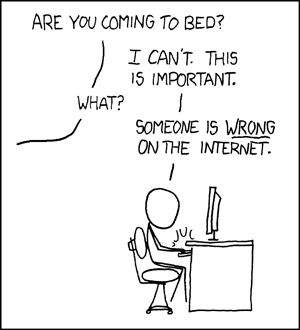 I found this on a forum I frequent and it feels good to know that I'm not alone.
Well, I might not currently be living together with anybody but my quest to correct people is a life long undertaking. Seriously though, I don't know if I'd say that I'm a know-it-all but I like to add my opinions whether they are asked for or not and many a time that has been viewed as me being a smart arse. Considering several of the interactive parts of the internet is just full of peoples views on things though I like to consider myself as a contributor to the vast knowledge of internet ... ok, so I might be a bit of a know-it-all after all.
Anyway, I thought this picture was hilarious and so I wanted to add it to this blog too in the off chance that somebody takes a look here and finds it funny too and spreads it on.
Saturday, 9 February 2008
What is politics good for ...
... when religion controls the world?
I watched a video on Youtube the other day, it was an act by Marcus Brigstocke concerning religion. While it was funny it also got me thinking, which I'm sure was also one of Brigstocke's goals when he made the thing. While thinking is usually something that I detest and that makes my head hurt it made me rather sad actually this time. Because the more I thunk about religion and the fact that the great star of democracy called US of A just barely drag itself into the land of democracy these days when they climb over the great 50% threshold of people participating in the election, I came to the conclusion that it's no real bloody point to the whole thing.
Bare with me here for a second (or ten), I vote and I participate in the democratic process in my own country and I hate when people say that there isn't any point to go to the urns because it doesn't really matter who is in power since we are going to have just about the same government anyway. While this is more true for USA than my own country it still isn't an excuse for not voting in my opinion. If you don't participate you can't sit around and complain either and since I love complainin' I'm also votin' ;)
So what do I mean when I say that there is no point? Well, lately I've come to the conclusion that no matter what cool ideas our politicians come up with it's all going to come down to religion in the end any way. Today we, in the west, live in a rather un-religious world but many parts of it is still controlled by the religious ethics and rhetoric and so no matter what great strategy we come up with in the end there is always going to be a bloody religious nut standing in the way of progress and peace.
So there you have it good folks, if there is something we really should work towards it's the abolishment of religion and then we can start thinking about political agendas because not until then will there be any point to doing something about the political aspect of things. Until we have a world that isn't controlled by religious believes I'll just quote Rage Against the Machine, "Fuck you, I won't do what you tell me" and keep living with respect of my fellow man but kick against the pricks.
/Peace
I watched a video on Youtube the other day, it was an act by Marcus Brigstocke concerning religion. While it was funny it also got me thinking, which I'm sure was also one of Brigstocke's goals when he made the thing. While thinking is usually something that I detest and that makes my head hurt it made me rather sad actually this time. Because the more I thunk about religion and the fact that the great star of democracy called US of A just barely drag itself into the land of democracy these days when they climb over the great 50% threshold of people participating in the election, I came to the conclusion that it's no real bloody point to the whole thing.
Bare with me here for a second (or ten), I vote and I participate in the democratic process in my own country and I hate when people say that there isn't any point to go to the urns because it doesn't really matter who is in power since we are going to have just about the same government anyway. While this is more true for USA than my own country it still isn't an excuse for not voting in my opinion. If you don't participate you can't sit around and complain either and since I love complainin' I'm also votin' ;)
So what do I mean when I say that there is no point? Well, lately I've come to the conclusion that no matter what cool ideas our politicians come up with it's all going to come down to religion in the end any way. Today we, in the west, live in a rather un-religious world but many parts of it is still controlled by the religious ethics and rhetoric and so no matter what great strategy we come up with in the end there is always going to be a bloody religious nut standing in the way of progress and peace.
So there you have it good folks, if there is something we really should work towards it's the abolishment of religion and then we can start thinking about political agendas because not until then will there be any point to doing something about the political aspect of things. Until we have a world that isn't controlled by religious believes I'll just quote Rage Against the Machine, "Fuck you, I won't do what you tell me" and keep living with respect of my fellow man but kick against the pricks.
/Peace
Subscribe to:
Posts (Atom)



 Posts
Posts

